Lotus Emira 420 Sport Review: Four-Pot Emira Goes Feral

Pros
- The best four-cylinder Emira yet......and the best full-stop for track driving
Cons
- Uncompromising on the roadThe V6 is still a nicer overall package
420 Sport? The Lotus Emira range is getting quite complicated.
It is, especially since new variants have been coming thick and fast over the last year or so. Right now, there are three different versions powered by Mercedes-AMG’s M139 2.0-litre turbocharged four-cylinder: the 360bhp Turbo, the 400bhp Turbo SE, and this, the 416bhp (420ps, hence the name) 420 Sport. They all come hooked to an eight-speed dual-clutch auto.

Separately to those, you can still get it with the 3.5-litre supercharged Toyota V6, now only available in kitted-out SE guise, with 400bhp and the choice of a six-speed manual or auto. Both engines, Lotus assures us, are fully homologated through to the end of the decade.
Back to the 420 Sport, though. As well as the extra power, torque is up to 369lb ft, a 15lb ft increase over the Turbo SE. 0-62mph takes 3.9 seconds, and top speed is 186mph, which makes it not only the quickest Emira variant yet, but, says Lotus, the fastest four-cylinder car in the world.
So the 420 Sport has more power. What else is new?

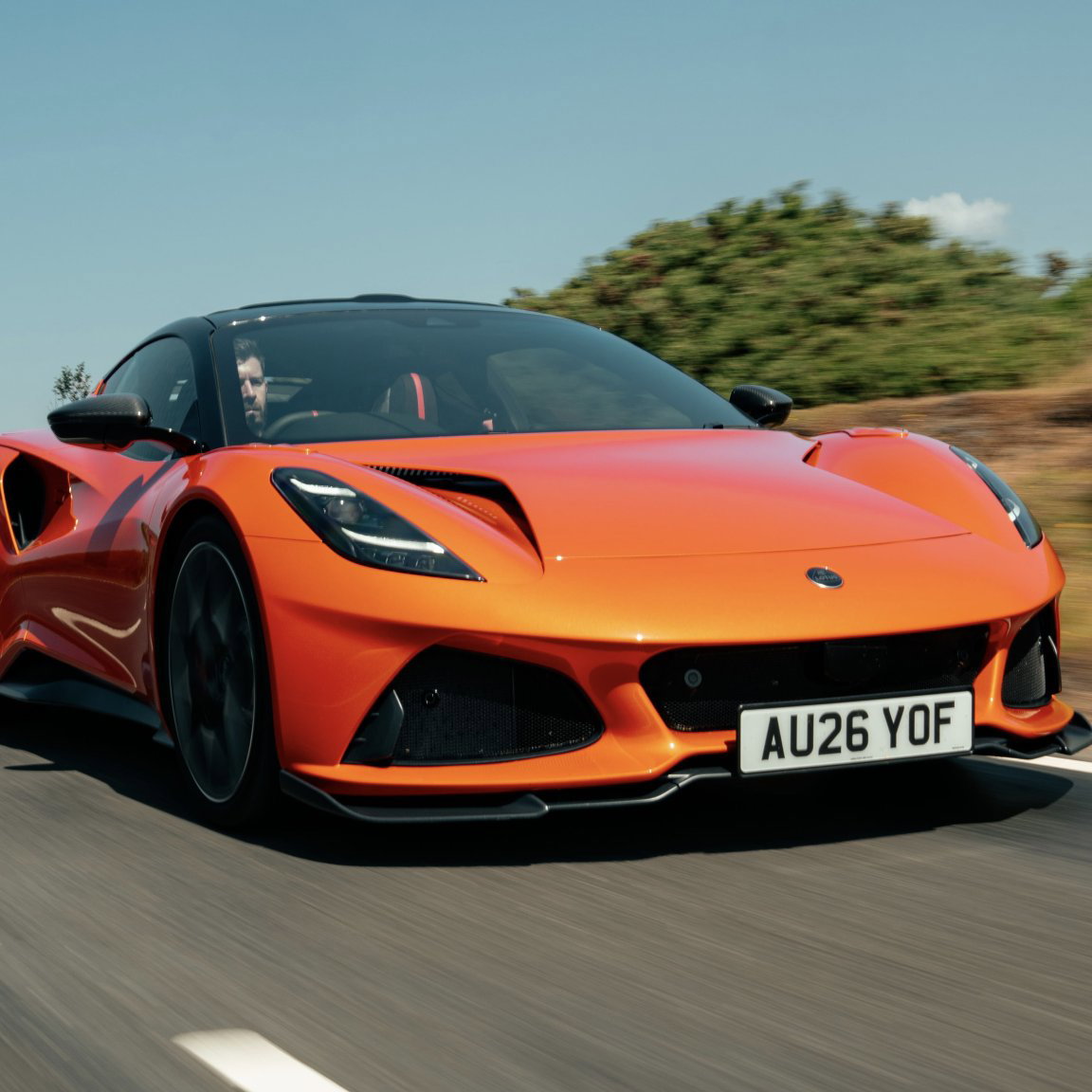
Plenty. It’s the most hardcore Emira yet, something that’s immediately apparent when you see its new extended front splitter, rear lip spoiler, slatted rear windscreen and louvres sitting atop the front arches. There are bigger air intakes too, which improve airflow to the radiators by up to 15 per cent, and the whole thing sits 5mm lower than standard.
Lotus has also developed a Lightweight Handling Pack, which brings a titanium exhaust, a lighter lithium-ion battery, a smattering of carbon fibre, a set of Michelin PS Cup 2 tyres and some Multimatic spool valve dampers, adjustable for bump and rebound through 11 clicks of stiffness. Optional 20-inch forged wheels are new to the 420 too, and with all the lightest bits fitted, it weighs in at 1,430kg, 16kg less than a base Emira Turbo.
There are a couple of notable changes inside, too. There are new, enlarged carbon fibre shift paddles, but the most notable addition is an ’80s-style detachable glass roof panel that turns the Emira into a nearly-targa top. Stowable behind the seats, it’s an option that’s been driven by demand for something convertible-esque from the US market, and while it debuts on the 420, it’s available on every Emira model as a £5,000 option.
All sounds positive.

Indeed it does, but there’s a catch. The last Emira we spent some time with was the Turbo SE, and while it offered plenty to like, we weren’t totally sold. That was partly because of the flat, emotionless engine and indecisive gearbox, and partly because of the sometimes punishingly firm ride on our Sport Chassis-equipped car.
There’s both good and bad news in these areas with the 420 Sport. The good is that Lotus seems to have fiddled with the gearbox, and left to its own devices, it’s far better at managing shifts when you’re just pootling about. When you’re not, there’s more incentive to take control yourself too, because those bigger, longer-travel paddles are way nicer to use than the piddly metal ones in other two-pedal Emiras.
The bad news is that the M139 engine is still rather plain for a car that otherwise looks and feels so exotic. We’d say the Handling Pack’s titanium pipes have liberated a little more raspy goodness, but overall, it still sounds flat and industrial at all but the upper reaches of the rev range. It remains the biggest fly in the four-pot Emira’s ointment, especially when the V6 version is right there, tempting you with its rich, burbly tones.
What’s it actually like to drive, though?

Fantastic, with a couple of caveats: this is not the Emira to buy if you’re mainly using it as a road car. That’s because, even with the Multimatic dampers left in a reasonably slack setting for our road test, it’s even more brutally stiff than the Turbo SE, to the point where the constant jiggling over the slightest imperfections quickly becomes tiring. The damping itself is fantastic, taking Norfolk's lumpy B-roads in its stride without ever threatening to get unsettled.
The steering will keep you busy, too. The Emira has an electro-hydraulic rack which, together with the 420’s extra-aggressive chassis, makes it one of the most beautifully talkative systems you’ll find on any modern car. The trade-off for this is that on the road, you’re constantly fighting the wheel as the Emira tramlines its way through ruts and gets knocked off-centre by cambers.

These are expected compromises with an explicitly track-focused car, though. Be prepared to live with them, and the underwhelming engine, and the Sport 420 is a delight. That wonderfully feelsome steering is also quick yet substantially weighty, and is connected to an incisive front end that can be tipped into corners, allowing the Emira’s mid-engined layout to pivot it through them gracefully. In warm, dry weather, grip from the Cup 2 tyres is as massive as you’d expect.
The brakes, still the same two-piece items found on lesser Emiras, but now cooled 10 per cent more effectively, are plenty strong enough for a relatively lithe car like this, and the pedal is firm and progressive beneath your right foot.
The engine, for all its lack of emotion, is still an almighty thing. With broad, strong reserves of torque and almost non-existent turbolag, it makes the 420 feel ferociously, endlessly quick. Truthfully, on raw performance alone, it feels as though it’s knocking on the door of junior supercar territory, especially with the dual-clutch ’box banging out such rapid, smooth shifts.
Did you drive it on track?

We did, getting a good chunk of time on Lotus’ fast and lightly scary test track at its Hethel HQ (also the site of a newly opened ‘Performance Hub’, where Lotus plans to carry out contract engineering work for other manufacturers).
As you might have guessed by now, this is where the 420 Sport really shines. Here, the stiff damping doesn’t matter one jot, especially it’s this good at allowing the car to attack kerbs without drama, and you can really throw it into a bend and feel quite how eagerly it turns in and grips up. Several hard laps showed little evidence of brake fade, despite the Emira using trad steel items rather than carbon ceramics.
It’s relentlessly composed on a circuit, but still has a sense of humour, especially if you switch it into Race mode and slacken off the ESP, allowing you to really play with the mid-engined setup and bring that inherent desire to pivot around a mid-point into play. While it’s not the best Emira on the road, it’s undoubtedly the one to aim for if track days are a big part of your plan.
What’s it like inside?

Like every other Emira: a massive step up in quality and usability over past Loti, and a properly premium-feeling product. The detachable glass roof panel adds a delightful extra dimension, too. In place, it makes the cabin a much brighter, airier place, and removed, you get a sort of convertible-lite experience, although the buffeting becomes pretty severe at motorway speeds.
It’s not perfect, mind. The touchscreen can be sluggish and the text is too small to read on the move. And why, in a car like this, does it take two presses of a switch awkwardly tucked behind the gear selector to engage Sport mode? There should simply be a big red button marked ‘SPORT’. Oh, and the slatted rear screen all but kills rear visibility, but it makes you feel like you're in a Ferrari F40, so it's worth it.
The biggest issue, though, are the seats. The 420 Sport gets the same 12-way adjustable items as the rest of the range. They sit tall drivers a smidge too high and aren’t all that comfortable, and when you’re really pushing on, don’t offer enough bolster support. The whole range could do with the option of a proper one-piece bucket, but especially the 420 Sport with its hardcore remit.
How much is it, what could I get instead, and should I buy one?

In answer to your first question, from £105,900. That makes it the most expensive Emira yet by nearly £10,000, and there's the added sting of the Lightweight Handling Pack, which frankly, you want, costing an extra £12,900.
As for rivals, well… the 420 Sport doesn’t really have any at the moment. What would have been its main competitors, the Porsche 718 Cayman GT4 and Alpine A110 R, have both recently disappeared, and there’s sadly very little left in this segment. Unless you’re willing to buy used, then the closest competitor we can think of is the new 402bhp, 180mph Morgan Supersport 400 – not as strange a comparison as it seems at first glance.
And should you buy one? That very much depends. If you have your heart set on an Emira and you’re planning on plenty of track-based helmsmithery, then yes: it’s by some margin the best version yet for pounding round a circuit, and that’s where it really comes alive.

If you’ll mainly be driving on the road, then the 420 Sport still represents a big step up over the lesser four-pot Emiras, but as long as that lovely manual V6 version exists, it’s still the one we’d choose as a daily. With both engines apparently still having plenty of life in them, let’s hope Lotus decides to combine both and create a harder, lighter V6 Sport model. That could really be something.

Currently a freelance journalist, Mike previously worked full-time for Car Throttle as a staff writer between 2024 and 2026.


Comments