Aston Martin DB12 S Review: How Much Difference does One Letter Make?

Pros
- Hugely engaging to drive fastDoesn't sacrifice touring ability
Cons
- Other GTs offer more comfort and luxuryGains over the standard car are seriously marginal
Ah, another Aston with ‘S’ stuck on the end of its name. What does that stand for?
Officially, nothing. Unofficially, ‘Slightly better than the standard one’. The Aston Martin DB12 S arrives a couple of years after the base car, which itself represents an almost immeasurably big leap from the underwhelming DB11 it replaced.
In fact, Aston’s current range of cars is the best it’s been in years. The DBX is one of the most complete fast SUVs around, the Vantage is now a proper supercar-fighting hot rod, and the Vanquish is a big, elegant mega-GT with a twelve-cylinder party piece under its bonnet.
The DBX and Vantage, have already been S’d in the past year or so, and the DB12 – the latest in Aston’s heartbeat range of 2+2 ‘DB’ grand tourers dating back to the 1950s – is the next to get the treatment.
Same sort of changes, then?

Bang on. This isn’t some sweeping, transformative update – more a series of marginal gains designed to eke a tiny bit more performance out of the DB12, and a tiny bit more money out of the bank accounts of buyers. Still available as a coupe or drop-top Volante, it sits above the standard car rather than replacing it. Pricing goes from £191,000 to £205,000 for the coupe, and jumps from £199,500 to £218,500 for the Volante.
The engine is still Mercedes-AMG’s 4.0-litre twin-turbo V8, in wet-sump M177 form, and the gearbox still a trusty ZF eight-speed auto. Torque remains the same at 590lb ft, but power rises from 671 to 690bhp. The effect of this extra power is pretty negligible – top speed is exactly the same at 202mph, and the 0-62mph run is cut by a mere tenth to 3.5 seconds, but hey, it’s something for owners to brag about.

It’s not even the extra shove that’s really responsible for the slightly quicker acceleration. Aston says it’s more down to tweaks to the launch control which halve the gearshift times. The throttle pedal, steering and e-diff have all had calibration tweaks too, with the aim of tightening up response and feel, moving the DB12 S ever further towards the sporty end of the GT spectrum.
Also aiding that is new software for the the tricksy Bilstein DTX adaptive dampers, a stiffened rear anti-roll bar and reworked suspension geometry. Carbon-ceramic brakes, optional on the regular DB12, are standard-fit on the S. They not only bring the usual benefits in stopping power and heat management, but save a hefty 27kg of unsprung mass.
Oh yeah, and in a refreshing reversal of the way most cars are going, the S is actually 1.5dB louder than the base car if you go for the optional titanium exhaust, which also saves a further 11.7kg. Go for the standard system and you still get a new quad-pipe arrangement that’s been retuned for more V8 goodness.
How can I tell it apart from a standard car?

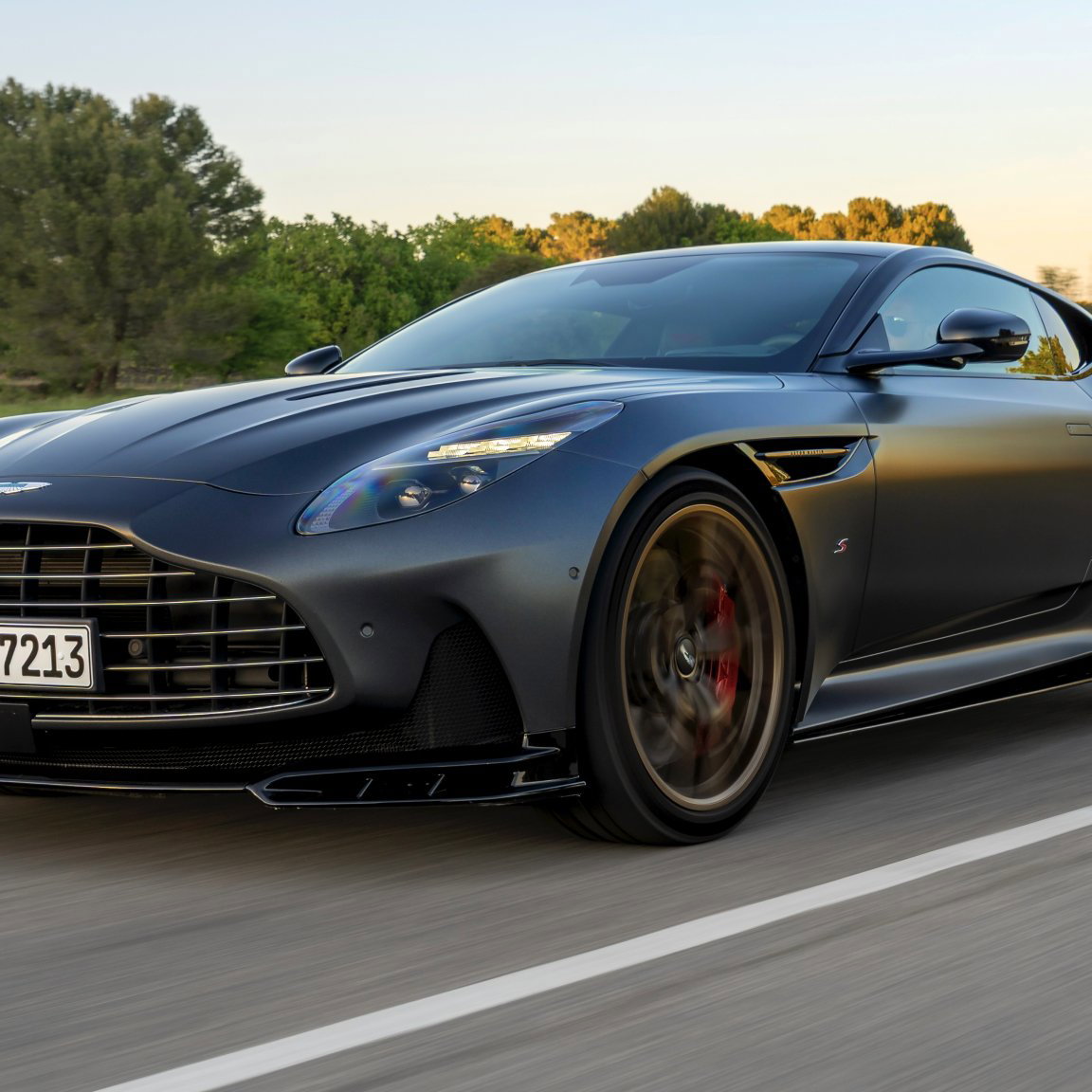
The first things you’ll likely notice are a new, more aggressive front splitter, then the gloss black sill extensions. Then, there’s an enlarged pair of nostrils on the bonnet which let the engine breathe a tiny bit easier. At the back, there's a larger rear diffuser, a small fixed lip spoiler replacing the active one on the standard car, and those new pipes.
Inside, there’s the option of a smattering of S-exclusive red accents, and you can spec the seats with three different tones of leather, allowing buyers free range to go as tasteful or as eye-searing as they like. Oh, and if you somehow still haven’t got the message from all this, there are many red S badges inside and out, too.
So, what’s it like?

Well, the standard DB12 already marked a noticeable shift towards a more hardcore character for Aston’s DB-series cars, and unsurprisingly, with its more aggressive setup, the S only takes this further. It doesn’t feel as if it wants to instantly catapult itself towards the horizon like the smaller Vantage, but at a cruise, even on marble-smooth French motorways, you’re made aware of little imperfections as they send a gentle thunk through the car.
That’s not to say it won’t play the continent crosser, though. Quite the opposite. Wafting along in the softest GT mode, the engine is whisper-quiet, and the standard Sport Plus seats are fantastically comfortable. It won’t eat up miles in quite the imperiously unbothered way a Bentley Continental GT will, but it’s really not that far off. It’s perfectly docile at town speeds too, once you’ve wrapped your head around the dimensions of its massive, thrusting bonnet and bulging hips.
Presumably you’ll be having more fun than a Continental GT, too?

Oh yes. Make no mistake, the new Continental is a hugely impressive car, but there’s ultimately only so much that mind-bending engineering can do to mask that it’s a 2.3-tonne, all-wheel drive hybrid. At 1,788kg with all the lightest bits stuck on it, the DB12 S weighs an entire Caterham less, sends its power to the rear, and is entirely free of electrification. All that has a profound effect.
For a turbo engine, the V8’s response is astounding, and while you’d really need to drive it back-to-back with a standard car to feel the true effects, the sharper throttle really does feel like it’s made a difference. Whether you’re leaving the car to it or taking control via the pleasing metal paddles, gearshifts are crisp and immediate, with a satisfying whump in the more aggressive drive modes.

The steering is just lovely: weighty, immediate and imbued with just enough little kicks and wriggles of feel, and the whole chassis is hugely confidence-inspiring for a car that’s sending 690bhp to the rear wheels alone. In more aggressive modes, those Bilstein dampers that imbue the car with ample grace and poise at a cruise give it a real fluidity and stability under hard cornering, keeping things flat and level.
You can really lean on the e-diff, too, feeling it hooking up and working together with the Michelin PS 5 S rubber to keep things nice and composed and egging on you on to get on the power ever earlier, although if you really start taking liberties, it’ll naturally warn you of its sheer potency with a stab of wheelspin.
And the interior?

Save for the visual changes mentioned above, largely identical to the standard DB12, which is to say: excellent. From the fussy, dated-looking Aston interiors of a generation ago, the company has taken huge strides to make its cabins look fresh without falling into the trap of annihilating all the buttons. Said buttons, along with all the other touchpoints, have a beautifully satisfying, high-quality feel to their operation.
There is one big change to speak of, albeit one that’s also being rolled out onto the standard DB12. iPhone users can now use Apple CarPlay Ultra, which made its debut in the DBX S. As well as doing all the usual CarPlay stuff, it replaces the instrument cluster with an Apple-specific one – not something we’re sure anyone was asking for, but it’s undeniably clearer and more legible than Aston’s own digital instruments.

It has other benefits too – changes to the heating and ventilation are now communicated within CarPlay rather than interrupting it, and if you disengage the lane-keep assist via the centre console button, the screen offers you a quick shortcut to turn the other driver assists off. It seemed to generally run smoother here than when we tried it in the DBX S last year, too.
So should I buy one?

Depends what exactly you want from your twin-turbo V8 ultra GT. If utmost comfort and luxury are priorities, then a Bentley Continental GT bests the Aston. Similarly, a Ferrari Amalfi will likely be a marginally sharper thing to hammer down a mountain road in. But a good GT should expertly blend those two traits, and the DB12 S does that very well indeed – its ability to go from placid, relaxed cruiser to thunderous sports car is remarkable.
The bigger question is whether you should buy one over a standard DBS, and this is a trickier one. As with the transition from DBX707 to DBX S, the changes are so marginal that it’s difficult to call without driving both back to back. The thing is, though, to a lot of people spending this sort of cash on a car, the £14,000 needed to upgrade to the S is probably a no-brainer, even if it’s just to get those badges that say ‘this isn’t a normal DB12’ – and it’s a decision we wouldn’t judge them for in the slightest.

Currently a freelance journalist, Mike previously worked full-time for Car Throttle as a staff writer between 2024 and 2026.


Comments