2025 Jeep Wrangler Review: Characterful But Outclassed

Pros
- Oozes characterHuge off-road talent
Cons
- Not great on the roadVery few opportunities to use that talent
Wait, you can still buy a Jeep Wrangler in Britain?
You can, although we don’t blame you if this comes as a surprise. New Wranglers aren’t exactly a common sight on our roads, and when you do see them rumbling through a quaint little village, they look about as misplaced as a classic Mini would on an empty stretch of Nevada highway.
But then that’s likely part of the appeal for the small but devoted bunch of British Wranglerists which is why, for now at least, Jeep still bothers to build it right-hand drive and send it over here.
Cool – it’s a big American off-roader, so I must be able to get some big engines.

’Fraid not. You can in the States, where the Wrangler is available with a gruff old naturally aspirated V6, as a plug-in hybrid (although chatter suggests this is soon to be dropped), and with a 470bhp, 6.4-litre Hemi V8 which we have to assume sits somewhere between hilarious and terrifying.
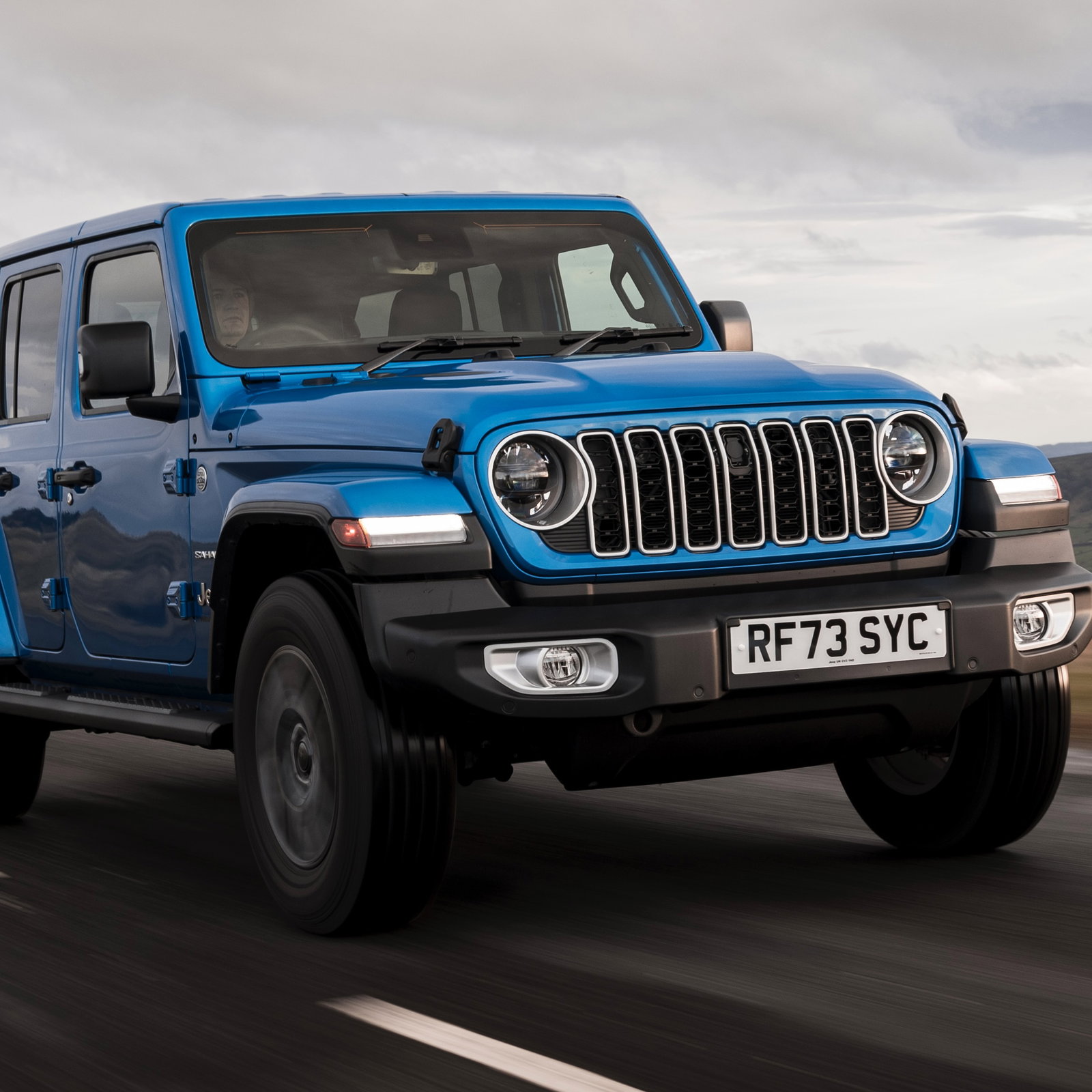
Since the model’s 2024 refresh, though, Britain’s just had the one option, a 2.0-litre turbocharged petrol four-cylinder. Doesn’t sound very Wranglerish, but the numbers – 268bhp and 295lb ft – are perfectly adequate for this sort of car. All that’s sent through ZF’s proven eight-speed automatic to a proper selectable four-wheel drive system. Jeep puts the numbers at 0-62mph in 7.6 seconds and a limited 99mph top speed (you really wouldn’t want to go any faster anyway).
We don’t have anywhere near as much choice in other areas, either – while the US gets two- and four-door bodies plus a pickup version called the Gladiator, and a baffling array of trims and special editions, in Britain it’s four-door only, and a choice of two trims: the Sahara we’ve been driving, or the Rubicon, which comes with slightly more kit and standard knobbly all-terrain tyres.
Must be a monster off-road.

Oh yes, which is why we spent most of our week with the Wrangler driving on-road. Oops.
Look, it’s not that easy in Britain to find places to safely, and indeed legally, drive properly off-road, and the fact is that most hardcore green-laners are going to be spending a few grand on bobtailed Discovery 2s and leggy Land Cruisers, not brand-new, £63k Jeeps. And because we had the Sahara, it was on road-biased tyres. Want any more excuses?
For what it’s worth, we did our best to seek out rutted, muddy forest tracks. Taking the Wrangler down these is like inviting Max Verstappen on a stag do go-karting afternoon. It doesn’t even need to try.

Our loan also coincided with the same freak dumping of snow in my neck of the woods that led to some rather festive-looking images of our long-term Dacia Duster. Again, none of this is an issue for the Wrangler, as long as you remember to slide the big drivetrain lever into four-wheel drive – otherwise, you might leave your neighbours wondering why this gigantic car – the very template for the term ‘off-roader’ – is struggling to get up a hill on a snowy residential street in Yorkshire.
The fact is, though, that anyone dropping big money on a new Wrangler in Britain is most likely to be doing so because they think it looks cool, not because they’re planning a month-long overlanding expedition.
Fair enough. What’s it like on the road, then?

Let’s call it tolerable. At the end of the day, it’s a huge body-on-frame 4x4 with recirculating ball steering that’s designed to take big bashes from rocks rather than be uber-precise and effortless.
As a result, you’re going to be doing a lot of winding on and off of lock around town, making lots of little corrections out in the open, and dealing with lots of lean through the corners. It’s a similar overall experience to the Ineos Grenadier, which uses the same fundamental chassis and steering recipe.
The four-pot engine’s adequately grunty for moving around the Wrangler’s 1938kg heft, although it’s not the most pleasant thing to use – buzzy and coarse at low speed, and quite noisy higher up in the rev range. Unsurprisingly, there’s lots of wind noise too, thanks to the shoebox aerodynamics.

The ZF ’box, meanwhile, is much as the trillion other cars you’ll find it in – fundamentally good – although in the Wrangler it’s been programmed to be quite lazy. This is presumably to allow you to make the most of the engine’s torque when off-roading, but it does sometimes leave you willing on downshifts.
Ultimately, all of this breed of rufty-tufty 4x4 – Wrangler, Grenadier, Land Cruiser, et al – are leaps and bounds ahead of where they used to be in usability terms, and you could plausibly drive the Wrangler day-to-day without it being too much of a chore. Fuel economy is about what you’d expect, though – Jeep’s pessimistic official figure of 25.4mpg combined is pretty much on the money.

Despite its obvious flaws, it’s a pleasingly involving thing to drive, the sort of car that makes you slow down and actually think about the inputs you’re making. As a result, pootling along at five tenths is where it’s happiest, especially because you can take the front roof panels out and turn it into a quasi-convertible. I only tried this briefly because, y’know, snow.
(And yes, with the right tools, you can take all the doors off, too. Apparently, though, doing this is a bit of a legal grey area in Britain because the mirrors come off with them.)
What’s it like inside?
Again, tolerable. There’s lots of cheap American-spec leather, not far removed from the sort you would have found in your Buick LaCrosse rental car in Orlando in about 1998, but it at least does what it’s supposed to in here, which is be functional.

You get plenty of chunky physical controls, because Jeep’s sensibly realised that people might be using a car like the Wrangler in situations where jabbing at a touchscreen isn’t the best idea. That’s especially welcome because the native Uconnect infotainment system is a bit naff. The joy of wireless phone mirroring kind of renders this criticism moot, though. All your vital live off-roading readouts do live on the screen, but they’re easily accessible if you need them.
Once you’ve actually managed to haul yourself into the thing, there’s lots of room front and back, although the 548 litres of boot space is pretty poor for such a big car. There would be a tiny bit more were it not for the fact that there’s a huge subwoofer in there, as if the Wrangler thinks it’s a Vauxhall Corsa Max Power cover car. This is admittedly quite amusing, but probably makes more sense during Spring Break on South Beach, when you’ve got all the doors and roof panels off and are blasting, erm… whatever people on Spring Break listen to.

A couple more notes: the Wrangler is one of a tiny handful of cars left on sale with analogue dials – a pleasing if inconsequential feature – and Jeep appears to have somehow distilled some air from Death Valley into the heated seats and steering wheel. This, as you can imagine, is very welcome in Britain in November.
So should I buy one?
Look, there isn’t really anything the Wrangler does that isn’t done better by rivals. The Ineos Grenadier is better at doing the no-holds-barred, GoreTex-laden 4x4 thing. A Land Rover Defender, meanwhile, is miles better at day-to-day stuff and can still more than hold its own in the rough, and the latest Toyota Land Cruiser sits in a more comfortable middle ground than the Wrangler. All of those come with the option of diesel power, too, which make a lot more sense than the Jeep’s thirsty petrol four in Britain.

If the Wrangler was still a £40,000, or even £50,000, car, all of this would be a lot more forgivable, but it’s not – it’s £63,465 at the very least. That’s right in the same ballpark as a basic Defender 110 or Grenadier Station Wagon (although a heck of a lot less than the £80k a Land Cruiser costs these days).
In most areas, the Wrangler is simply a bit outclassed by these rivals. However, it does have absolute bags of character. People come over and enthusiastically ask questions about it, children excitedly point at it, and in spite of its various flaws, driving it puts a big smile on your face.

It’s for these reasons that, however small its audience may be, there’s still a place for it in Britain for now, even if chances to use its considerable off-road talent are few and far between. It’s a big, silly, loveable car, and – in a new car market that’s ever more averse to risk and, seemingly, fun – big, silly, loveable cars are all the more important.
The stats (Wrangler Sahara)
- Engine: 2.0-litre turbocharged four-cylinder, petrol
- Gearbox: eight-speed automatic
- Power (bhp): 268
- Torque (lb ft): 295
- 0-62mph: 7.6 seconds
- Top speed: 99mph
- Weight: 1938kg
- Starting price: £63,465

Currently a freelance journalist, Mike previously worked full-time for Car Throttle as a staff writer between 2024 and 2026.


Comments